Legal Resources

Find websites and materials written in plain language.

Logo with six rectangles and a circle in six bright colours to represent people, and "People's Law School."

Making a Claim for Workers’ Compensation

People’s Law School
Explains how workers’ compensation works and who can get it. It describes the benefits you might be entitled to if you suffer a temporary disability, or are permanently disabled, and the benefits for families of workers. It explains the steps you need to take to make a claim.
Last reviewed October 2025
Logo with six rectangles and a circle in six bright colours to represent people, and "People's Law School."

Discrimination in Housing

People’s Law School
Explains how to identify discrimination in housing and what steps to take if you’re discriminated against. Whether you’re renting, living in a strata, or buying a home, you can’t be treated badly or unfairly because of certain parts of your identity, such as race, sex, or any disability.
Last reviewed July 2025
Logo with six rectangles and a circle in six bright colours to represent people, and "People's Law School."

The Employer’s Duty to Accommodate

People’s Law School
Explains which human rights laws apply to your employer. When a personal characteristic protected under human rights law is involved (such as religion, age, disability, or sex), employers must do what they can to accommodate these differences. The page explains how to ask your employer for accommodation, and answers common questions.
Last reviewed October 2025
Logo consists of four coloured shapes forming a square, with the organization name to the right.

Inclusive Investing: Respecting the Rights of Vulnerable Investors through Supported Decision Making

British Columbia Law Institute
These resources explain supported financial investment decision-making for adults living with dementia and other disabilities. They include guides for family and friends helping with decision making, as well as suggestions for facilitators. The resources include Help People Living with Dementia to Understand Their Investment Decision-Making Rights...
Last reviewed December 2025
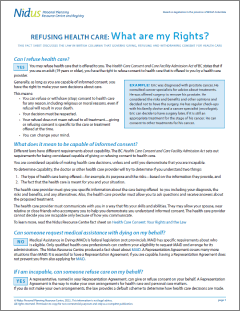
Thumbnail of the first page, with title, text, and Nidus logo.

Refusing Health Care: What Are My Rights?

Nidus Registry
This fact sheet answers questions based on BC law about health care consent like: Wills, Estates and Planning.
Last reviewed November 2025
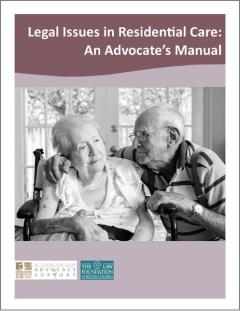
Thumbnail of the cover, with a photo of an elderly woman in a wheelchair, and an elderly man with his arm round her.

Legal Issues in Residential Care: An Advocate’s Manual

Seniors First BC
This manual describes the key legal issues related to residential care in British Columbia, along with the appropriate processes and available legal or administrative remedies.
Last reviewed November 2025
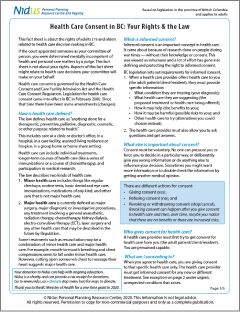
Thumbnail of the first page, with title, text, and Nidus logo.

Health Care Consent in BC: Your Rights and the Law

Nidus Registry
This fact sheet is about your rights as an adult (age 19 or older) to give or refuse consent to health care and includes answers to questions like: How is health care defined? What is required for informed consent? How is incapability to consent determined? When is consent not required? Who qualifies as a health care provider?
Last reviewed November 2025
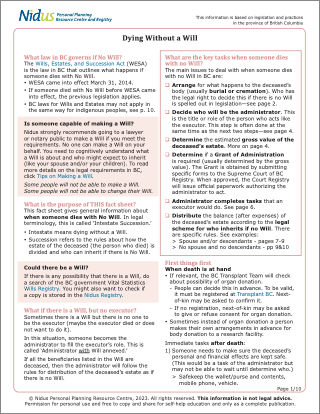
First page of help sheet with text in two columns.

Dying Without a Will (Intestacy)

Nidus Registry
Nidus encourages everyone to make a will. However, there are some situations where an individual may be considered not mentally capable to make a will. This fact sheet explains who has legal authority to settle an estate and gives examples of how an estate must be distributed if there is no will.
Last reviewed November 2025
Organization logo of "TRAC" with the "A" shaped like a house.

Your Tenancy: Human Rights

Tenant Resource & Advisory Centre (TRAC)
While the Residential Tenancy Act is the main piece of legislation that governs tenants’ and landlords’ rights and responsibilities, section 10 of the BC Human Rights Code gives tenants further protections when it comes to discrimination in tenancies. This resource explains the basics of the Human Rights Code as it applies to tenancies.
Last reviewed July 2025
Logo shows the letters "PGT" in shades of blue and green, with the organization name to the right.

Protecting a Vulnerable Adult From Abuse, Neglect or Self-Neglect

Public Guardian and Trustee of British Columbia
Describes what abuse, neglect, and self-neglect are, what a designated agency can do, and how the community-response network aims to provide a coordinated response to these complex problems.
Last reviewed March 2024