
Health & safety at work
Last reviewed November 2025 by the Clicklaw editors
Your employer must provide a safe workplace free of hazards that may lead to injury or illness. Employers must also be vigilant about threats that can profoundly affect mental health and overall well-being — including sexual harassment and discrimination.
Explore the links below to reliable online guides and tools and to organizations in BC. They have been chosen by librarians at Courthouse Libraries BC.
Selected resources
Click on a topic to see a list of resources.
|

Farm Workers and Rights at Work
People’s Law School
Explains farm workers’ rights under BC’s main employment law. Topics include who is considered a farm worker under the law, and what happens if an employer doesn’t follow the minimum standards. It explains what benefits you're eligible for, and more.
Last reviewed October 2025
Discrimination in the Workplace
People’s Law School
Being treated differently than others based on personal characteristics is called discrimination. The law protects you from discrimination at work. Learn your rights and options if someone discriminates against you.
Last reviewed October 2025

Prohibited Actions Relating to Occupational Health & Safety
Government of British Columbia
Explains that your employer or union cannot retaliate against you if you raise an occupational health and safety issue, refuse unsafe work, and more. It gives examples of some prohibited (retaliatory) actions. It also explains what you should do if you have a complaint, and the options for resolving your complaint.
Last reviewed October 2025

Communicable Disease Prevention
WorkSafeBC
A web page with information about communicable disease, how to prevent it in your workplace, and how to respond to periods of elevated risk.
Last reviewed October 2025

Activity-Related Soft Tissue Disorders
Workers’ Advisers Office (Government of BC)
An overview of activity-related soft tissue disorders, also known as repetitive strain injuries. This is when repetitive movements or vibrations injure muscles, tendons, and ligaments. Workers can receive compensation if work-related factors contribute to the condition.
Last reviewed October 2025
The Employer’s Duty to Accommodate
People’s Law School
Explains which human rights laws apply to your employer. When a personal characteristic protected under human rights law is involved (such as religion, age, disability, or sex), employers must do what they can to accommodate these differences. The page explains how to ask your employer for accommodation, and answers common questions.
Last reviewed October 2025
Mental Health and Rights at Work
People’s Law School
Explains that mental health issues are common, and it’s okay to reach out for help. The page has information about your legal rights, including when applying for a job, disclosing mental health issues while on the job, if you’re treated badly or fired because of mental health issues, or if you can’t work because of mental health issues.
Last reviewed October 2025
Avoiding Problems with Your Claim
Workers’ Advisers Office (Government of BC)
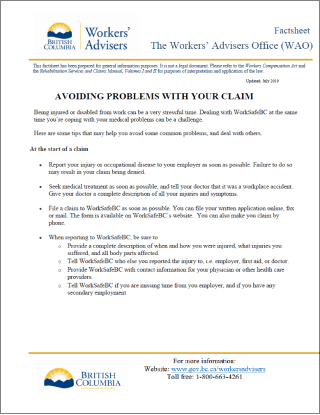
Guidance for those who have been injured or disabled from work and are planning to file or have filed a WorkSafeBC claim. It lists what to do at the start, advises you to follow up with your doctor regularly and to document all communications, and explains how to challenge a decision or file a complaint.
Last reviewed October 2025

Federal Workers’ Compensation Service
Government of Canada
The FWCS processes compensation claims submitted by federal employees who have suffered a work-related injury or illness. The page links to compensation for federal workers, merchant seamen, survivors of employees slain on duty, locally engaged foreign citizens, federal inmates, and more. It includes information on how to track claims data.
Last reviewed October 2025
Foreign Workers
Government of British Columbia
This is for workers who are not citizens or permanent residents of Canada. It includes information about compensation claims, including what you should do if you’re injured at work, or develop a work-related disease. It explains how you make a claim with WorkSafeBC. It also explains workplace health and safety.
Last reviewed October 2025
Making a Claim for Workers’ Compensation
People’s Law School
Explains how workers’ compensation works and who can get it. It describes the benefits you might be entitled to if you suffer a temporary disability, or are permanently disabled, and the benefits for families of workers. It explains the steps you need to take to make a claim.
Last reviewed October 2025
Permanent Disability Awards
Government of British Columbia
Explains you may be eligible for permanent disability benefits if you had a work-related injury or illness that permanently impacted you or your ability to work. Topics include what to expect when you’re referred to Long Term Disability Services, and how the benefits are calculated.
Last reviewed October 2025

Solution Explorer: Small Claims
Civil Resolution Tribunal (CRT)
The Solution Explorer is the first step in the online Civil Resolution Tribunal (CRT) process, with free legal information and self-help tools. You can apply to the CRT for small claims dispute resolution right from the Solution Explorer.
Last reviewed January 2026

LSLAP Manual: Workers’ Compensation
Law Students’ Legal Advice Program (LSLAP)
This chapter on workers’ compensation is from the manual used by law students handling cases at LSLAP’s legal clinics. It provides an overview of the law relating to compensation for workplace injuries or illness, and describes the claims and appeal procedure.
Last reviewed November 2025